Setting Our Paths Straight


TWENTY-third SUNDAY IN ORDINARY TIME (SEPTEMBER 4, 2016)
A little over a week ago I was in Korea. On my last day there, I visited a former leper colony (now leprosy is referred to as Hansen’s Disease) on Sorok Island just off the mainland of South Korea, near the southwestern Korean city of Gwangju. It was a deeply shocking, deeply moving experience. The island was established as a kind of ghetto for persons with Hansen’s Disease in 1916, during the Japanese occupation of Korea that lasted until the end of World War II, in 1945. Anyone in Korea who contracted the disease was sent to Sorok Island and was basically abandoned there, guarded by Japanese troops and often cruelly treated, even put in solitary confinement. Since the disease was regarded as transmitted genetically, male victims were subjected to castration, and women, if they were found to be pregnant, were forced to have an abortion. Even after liberation and independence in 1945, the Korean government continued to treat the inmates of Sorok Island as non-humans, and there is recent evidence that the hospital workers and security personnel massacred some 84 patients in 1948 when the patients protested their inhuman treatment. Even after 1963, when South Korea abandoned it’s segregation policy for victims of Hansen’s Disease, human rights abuses on the island continued for years. You can read about the island in a recent article: http://www.dailymail.co.uk/news/article-2512729/Former-inmates-Koreas-brutal-leper-colony-return-island-peaceful-sanctuary.html.
As I say, my visit to the island, especially learning its history in a powerful exhibit on the island’s museum, was a deeply moving experience. But, not only did it shock me to learn how suffering people were subjected to such inhuman treatment and abuse. What was just as powerful for me was to realize how we even today treat people with whom we are not comfortable in the same kind of inhuman way. I began to think of migrants here in the United States and elsewhere in the world. I thought of people with AIDS, or homeless people that I see every day in my Hyde Park, Chicago neighborhood. I thought of people who have identified themselves as transsexuals, and the controversy over bathrooms and locker rooms that is raging in the US today.
In the world of the New Testament, persons regarded as non-human were people like Onesimus, the runaway slave that Paul is trying to restore to his “owner,” Philemon. In his brief letter to Philemon, Paul is being very crafty. He himself recognizes Onesimus’ personhood, especially because of his baptism, which has made him “neither Jew nor Greek, slave nor free, male and female” (Gal 3:28). He sends Onesimus back to Philemon, acknowledging the fact that Philemon still “owns” Onesimus, and yet also reminding him that, as a Christian, he is “more than a slave, a brother, beloved especially to me, but even more so to you, as a man in the Lord.” Paul basically says that if Philemon regards him as a brother and partner, he should do the same with Onesimus.
Perhaps this is a clue to Jesus’ harsh-sounding pronouncements in the gospel reading. Onesimus was legally Philemon’s “possession.” But if he was to be a disciple, Philemon really has to renounce that “right.” In fact, if anything gets in the way of discipleship—no matter how much it might cost us, no matter how much it might take us out of our comfort zones—it needs to be given up. In extreme cases this might mean going against even our families, if they stand in the way of discipleship. Ordinarily, though, it’s other “possessions” that stand in the way. My experience on Sorok Island had caused me to think of the “possessions” I have in my attitudes to other people who make me uncomfortable and might even disgust me. That’s the kind of thing I need to let go of. They are people too. Just like the victims of Hansen’s Disease on Sarok Island. Just like people who are soliciting my change on the street here in Hyde Park, or who have discovered a new sexual identity.
Jesus calls us to leave comfortable attitudes behind. Like the first reading from the book of Wisdom, he calls us to recognize that God’s perspective on things may be radically different from our own. “Who can know God’s counsel, or who can conceive what the Lord intends?” Only as disciples of Jesus, only as women and men who are bent in giving up every “possession,” can we open up to God’s Spirit, the only one who make “the paths of those on earth … straight.”Image: Sorokdo Landscape by Jewel457, found on Wikimedia Commons under a Creative Commons (CC) License.
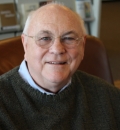 Stephen Bevans, SVD
Steve Bevans is Professor Emeritus at Catholic Theological Union and the Faculty Moderator for Catholics on Call. He is a Roman Catholic priest in the Society of the Divine Word, an international missionary congregation, and served for nine years (1972-1981) as a missionary in the Philippines.
His publications include: Models of Contextual Theology (2002), Constants in Context: A Theology of Mission for Today (2004, with Roger Schroeder), Evangelization and Freedom (2009, with Jeffrey Gros), and Introduction to Theology in Global Perspective (2009).
He is past president of the American Society of Missiology (2006) and past member of the board of directors of the Catholic Theological Society of America (2007-2009). In 2009 he was visiting lecturer at Yarra Theological Union in Melbourne, Australia, and in 2013 he was the only Catholic to speak at a Plenary at the Tenth Assembly of the World Council of Churches in Busan, Korea.