
Food For Life


Scripture Reflection for the Twentieth Sunday in Ordinary Time (August 16, 2015)
Scripture Readings:
Proverbs 9:1-6
Psalm 34:2-3, 4-5, 6-7
Ephesians 5:15-20
John 6:51-58
"Whoever eats my flesh and drinks my blood has eternal life" (John 6:54)
"How can this man give us his flesh to eat?" One's sympathies easily go with the people who ask this question in today's Gospel, struggling to understand what Jesus meant by offering as "bread" his "flesh for the life of the world." The previous part of the discourse, heard last Sunday, which focused on "bread" as instruction, asking for a response of belief, was difficult enough. The shift this Sunday to "eating his flesh" strains to the limit of our ability to comprehend and respond. Elsewhere in Scripture this expression carries a very negative connotation. "Devouring flesh" is the action of evildoers from which the psalmist prays to be delivered (Ps 27:2). Drinking blood is forbidden because the life is in the blood, over which only God has power (Gen 9:4; Deut 12:23; Acts 15:20).
Coupled with the first reading, we can see in John's Gospel clear parallels between Jesus and Woman Wisdom. She prepares her meat and wine and sets her table and calls out to all to come and partake. She offers instruction to the simple and understanding that leads to life. Likewise, in the prologue (John 1:1-18) there are other unmistakable parallels between the Logos and Wisdom, who existed with God from the beginning (Prov 8:27; Wis 9:9 // John 1:1), "pitched her tent" among humankind (Sir 24:4, 8 // John 1:14), lights the path for them (Bar 4:2 // John 1:4-5), and yet suffers rejection (Prov 1:25, 29-31 // John 1:11).
It is in this likeness to a woman that we may find one way to understand Jesus' words in John 6:51-58. Just as a mother gives her very flesh and blood to nurture a new life carried within her, and then continues to feed the child from her own body after it is born, so Jesus nourishes with his very self all who are birthed to new life through him (John 3:3). Similar to the union of mother and child while the latter dwells in the womb, so Jesus promises, "Those who eat my flesh and drink my blood abide in me, and I in them" (John 6:56). The life that results is eternal (6:54, 58) and for the whole world (6:51). The mystery of how this life will last forever is also expressed by the Fourth Evangelist in a birthing metaphor when at the Last Supper Jesus likens his coming passion to the pangs of a woman in labor (John 16:21). The death of his earthly body is the birth to new life for all.
Some of the medieval mystics also found the image of motherhood a help for understanding the mystery of Jesus giving us his flesh to eat and his blood to drink. Julian of Norwich spoke of "God-all wisdom" as "our natural mother" and elaborated on how "a mother can give her child milk to suck, but our precious mother, Jesus, can feed us with himself. He does so most courteously and most tenderly, with the Blessed Sacrament, which is the precious food of true life" (see the translation of Julian's "Revelations of Divine Love" by M. L. Del Mastro [New York: Doubleday, 1977], portions of which are available online at http://www.gloriana.nu/mother.htm).
Our response to the One who gives his flesh and blood for our life and that of the world is not only intellectual assent. Jesus gives his "flesh and blood," an expression that connotes the whole person. So we entrust our whole selves to him, body, mind, and spirit, expressed in our physical partaking of the eucharistic body and blood. There is no adequate answer on an intellectual level to the question, "How can this man give us his flesh to eat?" Rather than trying to explain the "how," he simply invites us into the depths of the "who."
Praying With Scripture
1. Pray with the image of Jesus as mother who feeds us with his body and blood.
2. Ask Christ to draw you into his abiding love, letting go of questions of "how."
© Copyright 2015 Catholic Theological Union. All Rights Reserved.
These reflections are also available in Abiding Word. Sunday Reflections for Year B (Collegeville: Liturgical Press, 2011) 96-97.
Image: Detail from a church in Salamanca, Spain, by Lawrence, OP. Found on Flickr under a Creative Commons License.
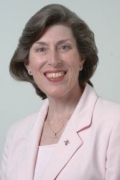 Barbara E. Reid, O.P., Ph.D.
Professor of New Testament Studies
Vice President and Academic Dean
M.A., Aquinas College; Ph.D., Catholic University of America
Barbara E. Reid, O.P. is a Dominican Sister of Grand Rapids, Michigan. She holds a Masters from Aquinas College in Religious Studies and a Ph.D. in Biblical Studies from The Catholic University of America in Washington, D.C. She is the author of Taking Up the Cross: New Testament Interpretations Through Latina and Feminist Eyes (Fortress Press, 2007), The Gospel According to Matthew, New Collegeville Bible Commentary Series (Liturgical Press, 2005), Parables for Preachers (3 volumes; Liturgical Press, 1999, 2000, 2001), Las Parábolas: Predicándolas y Viviéndolas (Liturgical Press, 2008, 2009), Choosing the Better Part? Women in the Gospel of Luke (Liturgical Press, 1996), A Retreat With St. Luke (St. Anthony Messenger Press, 2000), and many journal articles. Currently she is writing Sophia’s Table: An Introduction to Feminist Interpretation of the Scriptures (forthcoming from Eerdman’s Press) and is General Editor for a new 60-volume feminist commentary on the Bible (forthcoming from Liturgical Press). She writes the weekly column on “The Word” forAmerica magazine.
Books written by Barbara E. Reid