
The "Hidden" Resurrection


Scripture Reflection for the Resurrection of the Lord - The Mass of Easter Day (Sunday, April 5, 2015)
Scripture Readings:
Acts 10:34A, 37-43
Psalm 118:1-2, 16-17, 22-23
Colossians 3:1-4
John 20:1-9
On this Easter Day we reach "ground zero" of our Christian faith - the conviction that God's love is stronger than death. The destiny of Jesus, the Word of God made flesh, is the assurance of this astounding and challenging core of our Christian faith.
A few years ago I gave a Holy Week retreat for a community of sisters in Orange, California. At Mass on Easter Sunday we read the same Gospel selection - John 20:1-8 - that is read this year. Mary Magdalene, who has a prominent role in the Gospel of John as the first witness of the resurrection, comes to the tomb of Jesus early in the morning, now that the Sabbath has concluded. To her dismay, she finds that the stone that had sealed the tomb has been rolled away and the tomb is empty. She runs with this startling news to Peter and to the "Beloved Disciple," who is a privileged witness in John's Gospel. They in turn run to the tomb to see for themselves.
The Beloved Disciple runs faster than Peter (this disciple always seems to be a step ahead of Peter in John's Gospel) but then waits for Peter to catch up. While waiting for Peter he peers in the tomb and sees it is empty, as Mary had said. But not entirely so - the burial cloths that had enveloped the body of Jesus are there and the cloth that covered his head had been rolled up and put to one side. When Peter arrives the two disciples enter the tomb: the Beloved Disciple seems to have an inkling of what has happened but Peter has still not understood the astounding reality they are witnessing. Jesus was not to be found in the tomb - he had risen from the dead.
After the Easter Mass I celebrated for the sisters and their friends that day was concluded, a woman came to see me. She introduced herself as a psychiatric social worker who attended to prisoners in a nearby prison. Most of her clients, she explained, were young adults whose lives had been destroyed by drugs. She said when she heard this Easter Gospel she suddenly saw a connection with the experience of the young people she served. It was the detail about the burial cloths having been carefully laid aside in the empty tomb that had struck her. "Crucifixion is public," she said, "but resurrection is often more hidden and subtle."
Her clients' "crucifixions" were there for all to see: abuse of drugs, loss of job, no longer caring about their health or grooming, and then arrest and imprisonment - young lives seemingly ruined. But for some, after a long time and with some hard spiritual and psychological work to break loose from their addiction, life begins to seep back in: they comb their hair; they fold the blanket on their bed; they begin to face life again.
The woman observed that this pattern also seemed true of Jesus' passion and resurrection as portrayed in this Easter reading from John's Gospel. Jesus' suffering, condemnation and crucifixion were public for all to see. But his rising from the dead was more challenging to perceive. The subtle signs were there - his burial clothes had not been tossed aside by a grave robber but folded and put in order as the Risen Christ took on new life. It was an astounding reality that Mary and the disciples could only gradually absorb and believe. God's unending love had transformed the Crucified Jesus into the Risen and Living Christ. "God," as John's Gospel had earlier proclaimed, "so loved the world that he gave his only Son, so that everyone who believes in him may not perish but may have eternal life. Indeed, God did not send the Son into the world to condemn the world, but in order that the world might be saved through him." (John 3:16-17).
This is the exuberant message proclaimed in all of the readings for this Easter Sunday. The first reading is taken from a pivotal scene in the Acts of the Apostles: Peter's address to Cornelius and his family in Caesarea Maritima, the first Gentile convert and a Roman centurion to boot! Peter, who had witnessed the empty tomb, testifies that Jesus had been brutally put to death by crucifixion, "hung on a tree." Yet "God raised this man from the dead and granted he be seen ... by us who ate and drank with him after he rose from the dead" (Acts 10:39-41).
The responsorial psalm, citing Psalm 118, declares: "The stone which the builders rejected has become the cornerstone. By the Lord has this been done; it is wonderful in our eyes!" Paul tells his Corinthian community to "clear out the old yeast that you may become a fresh batch of dough!" The power of Christ's resurrection and the transformation it makes possible enable us to be thoroughly renewed so, Paul acclaims, "Let us celebrate the feast" (1 Cor 5:6-8).
On Easter Sunday, like Pentecost, the Church breaks out in a special hymn called the "sequence." The poetry of the Easter sequence sums up the exuberant joy of this feast - joy rooted in the core Christian conviction of the power of life over all forms of death - a power manifest in the resurrection of Christ:
"Tell us, Mary," the poem asks, "what did you see on your way?
[She replies],
"The tomb of Christ, who is living,
The glory of Jesus' resurrection;
Bright angels attesting.
The shroud and napkin resting.
Yes, Christ my hope is arisen..."
Christ indeed from death is risen.
Our new life obtaining.
Amen. Alleluia!"
The woman who spoke to me after Easter Mass was right. Often we are aware in ourselves and in the world around us of sufferings and failures. Today's feast urges us to find the beauty and the unquenchable power of life that through God's unconditional love is also present all around us. At a time when we can be discouraged by reports of terror and brutal, wanton death, we Christians are called to give witness, because of the resurrection of Jesus, that life is more powerful than death, and love is more enduring than hate.
This Scripture Reflection has been originally published at www.ctu.edu. © Copyright 2015 Catholic Theological Union. All Rights Reserved.
Image: Behind Bars by Emilio Küffer, found on Flickr under a Creative Commons License.
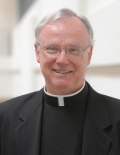 Donald Senior, C.P.
President Emeritus, Professor of New Testament Studies
Donald Senior, C.P., holds a Licentiate in theology (S.T.L.) from the University of Louvain, Belgium and a Doctorate in New Testament Studies (S.T.D.) from the University of Louvain. He has pursued further graduate studies at Hebrew Union College, Cincinnati, Ohio and at Harvard University.
A frequent lecturer across the country, Fr. Senior also serves on numerous boards and commissions. He is past President of the Association of Theological Schools of the United States and Canada. In 2001, Pope John Paul II appointed him as a member of the Pontifical Biblical Commission and was reappointed in 2006 and 2008 by Pope Benedict XVI. He has been active in interreligious dialogue, particularly with the Jewish and Muslim communities.
Fr. Senior is the General Editor of The Bible Today and co-editor of the twenty-two volume international commentary series New Testament Message. He is the General Editor of The Catholic Study Bible (Oxford University Press, 1990). He has authored and edited several books and articles.
Donald Senior is a member of the following professional associations: The Catholic Biblical Association of America; The Society of Biblical Literature; Studiorum Novi Testamenti Societas; The Chicago Society of Biblical Research; The Catholic Theological Society of America; The International Association of Missiological Studies; Pax Christi International.
He is also a past president of CTU.