
Flesh Matters!


Scripture Reflection for the Third Sunday of Easter (April 19, 2015)
Scripture Readings:
Acts 3:13-15, 17-19
Psalm 4:2, 4, 7-8, 9
1 John 2:1-5A
Luke 24:35-48
I find the scene of today's Gospel fascinating. Two excited disciples appear in the upper room on Easter evening where the terrified followers of Jesus are holed up. They try to explain how the Lord was made known to them in the breaking of the bread on the road to Emmaus. While they are telling the story Jesus himself appears. And what is the disciples' first reaction? Fear. When you think about it though, this is very understandable. After all - practically every one of Jesus' friends and disciples deserted him at his hour of greatest need.
The cowards ran away. And those who had not encountered Jesus on the road to Emmaus are still afraid. Peter might have been to the empty tomb earlier that morning, but he still doesn't know how to interpret the absence of Jesus' body despite the announcement of the resurrection by the women who had been to the tomb even before Peter. He undoubtedly still feels guilt for not only having abandoned his master, but for having denied Jesus three times. Could it be that now Jesus has come back as a vengeful ghost?
It is for this reason that the first words out of the Risen One's mouth are "peace be with you." Christ knows this frightened flock needs reassurance. They are forgiven and they have nothing to fear. He then makes it quite clear that he is not a ghost by inviting them to look at his wounds and touch him. And then he does something no ghost would or could do. The risen Christ eats with them. Just as Jesus did so many times during his earthly ministry to underscore peace and reconciliation, he shares food. The resurrection accounts in the Gospel all underline the bodiliness of the resurrection and its consequences for all of us. As St. Paul reminded the Romans: "Do you not know that all of us who have been baptized into Christ Jesus have been baptized into his death? Therefore we have been buried with him by baptism into death so that, just as Christ was raised from the dead by the glory of the Father, so we too might walk in newness of life."(Rm 6:3-4).
We also say it every Sunday in the Creed: "We believe in the resurrection of the body and life everlasting". But what do we mean by this?
In thinking about "spiritual things," we have been so conditioned by the Greek division of soul and body - that we invariably play down the body as somehow less important than the soul. But this is not the biblical notion at all. We are all of us en-fleshed spirits. Being around as just a spirit might be acceptable for some people, but an essential part of our identity is the body. "Who" we are is both soul and body. What we do in the body is important; but it is also true that the salvation in Christ that we are promised is not just partial - it is whole and entire. This was the ancient belief especially in the writings of the early Church: caro cardis salutis: "the flesh is the hinge of salvation." Flesh matters! Everything about us will be redeemed by God in Christ at the resurrection of the dead. Of course, we're speaking of a glorified body - recognizable as us, yet different - like the resurrected body of Christ himself.
Belief in the resurrection takes the physical world seriously. It emphasizes the confidence that Christians are called to have in a world completely redeemed by Jesus' suffering, death, and resurrection. The Resurrection is not only God's vindication of what Jesus taught and suffered, it is an affirmation of divine life and reconciliation that touches not just "the things of the spirit" but the entirety of creation. It was a challenge for the first disciples to understand and accept the reality of Christ's resurrection from the dead that brought them peace and forgiveness. It is an ongoing challenge for us today since we have experienced that living with the consequences of this good news is the work of a lifetime.
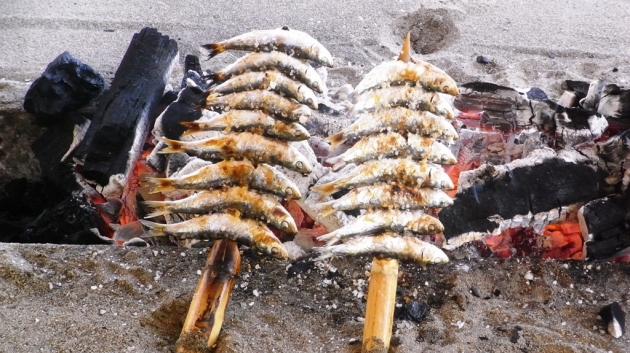
Image: Espetos de Sardinas by Javier Lastras. Found on Flickr under a Creative Commons License.
 Rev. Mark R. Francis, C.S.V., President
Fr. Francis is a member of the Clerics of St. Viator (Viatorians) and was ordained to the priesthood in 1982. He obtained a Master of Divinity degree and a Master of Arts degree in Theology from Catholic Theological Union (CTU). He served for three years in Bogotá, Colombia, and then, in 1988, he earned a Doctorate in Sacred Liturgy (S.L.D.) from the Pontifical Liturgical Institute of Sant'Anselmo in Rome. He taught liturgy at CTU for 12 years and was a regular lecturer at the Institute for Liturgical Consultants and its Spanish language counterpart. In 2000, he returned to Rome as Superior General of the Clerics of St. Viator, where he oversaw the mission of the international community until 2012. Fr. Francis was elected to the presidency of CTU on April 15, 2013.