
Until All Are Fed


SCRIPTURE REFLECTIoN FOR THE SEVENTEENTH SUNDAY IN ORDINARY TIME (July 26, 2015)
Scripture Readings:
2 Kings 4:42-44
Psalm 145: 10-11, 15-16, 17-18
Ephesians 4:1-6
John 6:1-15
This past Monday I was part of a liturgy preparation group within the community that I serve regularly, and we were all quite surprised by the line in the gospel that read, after Jesus has said “Let the people recline”: “So the men reclined, about five thousand in number.” Where were the women? one of the women in the group asked.
We then had a rather tense discussion as to whether, when I would read the gospel on Sunday, I should read the text as it is—the literal translation from the Greek—or change the wording to the more inclusive “people” or “everyone.” I wasn’t sure what we should do. I checked a Scripture commentary when I got home and read that this is how people were counted in Jesus’ day—by the number of men present. I also noticed that one translation—the New Revised Standard Version—used the word “people” for “men.”
Where were the women? They must have been there, as well as children—Matthew’s version of the story admits this. He writes that “those who ate were about five thousand men, not counting women and children” (Mt 14:21). What are we to make of this? Should we just gloss over the uncomfortable and exclusive wording and simply say “people” or “everyone”?
In don’t think so. As awkward as it is, I think the omission of women and children gives us a hint that the feeding of the crowd was a much bigger deal than even the text says. If there were five thousand men present, there probably were as many women—at least!—and probably a few thousand children as well.
That would place the crowd at about fifteen thousand. To get an idea of how many that would be think about the total crowd capacity of the United Center here in Chicago, where the Bulls and Blackhawks play. It’s 20,500. Or the crowd capacity for the Joyce Athletic Center at the University of Notre Dame, where both the women’s and the men’s basketball teams play. That’s 9,100. Compared to the number that were fed by Elijah in the first reading, this is an overwhelming number—a real sign that Elijah had come again, that Jesus was indeed the Messiah. No wonder he withdrew by himself, fearing that the crowd would make him king! The story is clearly a parable about the messianic abundance that the prophets predicted, when all would come to the Lord’s mountain and be fed with the best food and the choicest wines. It's a story about God’s generosity, about how much good God lavishes upon God’s creation, and upon humanity in particular.
This is why it is important to read the second reading from Ephesians in the light of such generosity. Paul charges the Ephesians to “live in the manner of the call that you received.” He calls them to live with humility and gentleness, with patience and love for one another, working for unity and peace. As God’s people, the Ephesians were the recipients of that messianic abundance, and so were to share it with one another by being generous in the way they lived with one another, and no doubt being generous to those around them.
This same abundance and generosity is ours as well, as Christians. We, like the Ephesians, are God’s messianic people, heirs to all the messianic promises told about in the first reading, but especially the gospel, and so we too are called to live in a way worthy of our calling, and be generous to one another and to the world. In our messianic community, we need to live in humility and gentleness. We need to bear one another patiently, and work at loving one another, and working for unity and peace as well. And we need to count women and children as well!
But living according to our calling is not just about becoming a better community as church. It means being generous in our world. When I began understanding the second reading from Ephesians in the light of the first reading and today’s gospel I thought of a song that I first heard when I attended the amazing Tenth Assembly of the World Council of Churches in Korea in 2013. The song is by Bryan McFarland, and it is called “Until All Are Fed.” The chorus goes like this:
Until all are fed we cry out
Until all on earth have bread
Like the one who loves us each and every one
We serve until all are fed
We serve until all are fed. Until all are fed with our humility and gentleness. Until all are fed with our patience and love and commitment to peace. Until all on earth have bread. Like the one who loves us each and every one—men, women, children, and the whole of creation!—we serve until all are fed!
Click here to listen to the song: https://www.noisetrade.com/bryanfieldmcfarland/until-all-are-fed
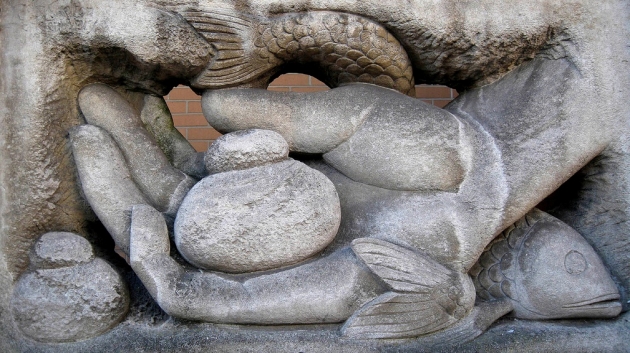
Image: Loaves and Fishes by John and Helen Mary Skelton. (Loaves and Fishes is set into the wall of the Brighthelm Church and Community Centre, North Road, Brighton, Sussex. It was unveiled on 10th October 1987.) Found on Flickr under a Creative Commons License.
 Stephen Bevans, SVD
Steve Bevans is Professor Emeritus at Catholic Theological Union and the Faculty Moderator for Catholics on Call. He is a Roman Catholic priest in the Society of the Divine Word, an international missionary congregation, and served for nine years (1972-1981) as a missionary in the Philippines.
His publications include: Models of Contextual Theology (2002), Constants in Context: A Theology of Mission for Today (2004, with Roger Schroeder), Evangelization and Freedom (2009, with Jeffrey Gros), and Introduction to Theology in Global Perspective (2009).
He is past president of the American Society of Missiology (2006) and past member of the board of directors of the Catholic Theological Society of America (2007-2009). In 2009 he was visiting lecturer at Yarra Theological Union in Melbourne, Australia, and in 2013 he was the only Catholic to speak at a Plenary at the Tenth Assembly of the World Council of Churches in Busan, Korea.