
THE Story is OUR Story


Scripture Reflection for the Seventeenth Sunday in Ordinary Time (July 29, 2012)
Scripture Readings:
2 Kings 4:42-44
Psalm 145
Ephesians 4:1-6
John 6:1-15
Click here for the podcast.
One of the great things about reflecting on the Sunday readings as they appear in the Lectionary—and not just as Scripture texts on their own—is that once in a while we get to hear the gospel reading in the way that the first Christians would hear it. Unlike us, the earliest believers had a keen sense and knowledge of the Old Testament. In fact, when they talked about the Scriptures, that’s what they were talking about, since the New Testament had not been written yet. And because of this, when they reflected on the life of Jesus and their own lives of grace, they saw all of it anticipated in many of the Old Testament stories and images, and used it to interpret what had happened in Jesus as well. As St. Jerome wrote famously in the fourth century, for the early Christians, the New lay hidden in the Old, and the Old became clear in the New.
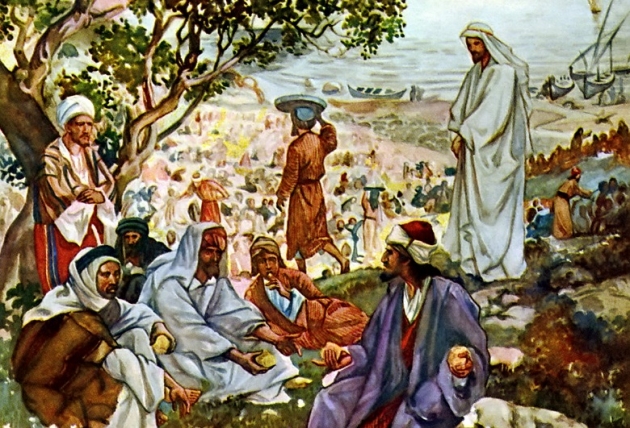
Today’s readings offer one of those once-in-a-while moments when the Lectionary lets us see this happen. When the early community read the story of the feeding of the five-thousand, they no doubt thought about what we read in the first reading from the Second Book of Kings—how Elisha the prophet fed a hundred people with twenty barley loaves, and there was food left over. Jesus’ story was Elisha’s story, and Elisha’s story was Jesus’ story.
But more than that! The first Christians knew the story of Elisha and how, as the successor to the great prophet Elijah, he had been given a “double portion” of Elijah’s spirit (2 Kings 2:9). And we see that “double portion” at work in our first reading today. Elijah in 1 Kings 17:8-16 comes across a widow in the village of Zarephath and asks her for food. She feeds him the last of what she has—there has been a great drought—but then the oil and flour with which she makes the meal is seen to never run out until the drought is over. Elijah, however, does not feed two persons—the widow and her son—but one hundred—how much greater than Elijah’s power is Elisha’s!!
But even more! Jesus is greater even than Elisha, who was two times greater than the great Elijah! Jesus feeds a crowd that is “about five thousand in number.” And not from one hundred loves, but from only five loaves and two fishes! The early Christians, with their keen knowledge of the Bible, would be amazed. Someone greater than Elijah was here. Someone greater than Elisha was here! Elijah’s and Elisha’s story was Jesus’ story, and vice versa.
And so today we are brought face to face once more with who Jesus is, and the readings call us to deeper faith in him—in his reality as greater than the prophets, as someone who sees our needs and attends to them, as someone who can and does offer us life and nourishment in abundance.
But there is one more message that I think our readings today offer. Not only do they call us once more to faith in Jesus. They call us to a faith in action, one that challenges us to generosity. What I’d like to suggest is that, in our readings today, The gospel story today—a part of THE story—is OUR story too.
Where we can see this is in a detail that appears in all three stories: a person shares the little bit that he or she has. In the Elijah story it was the unnamed widow. In the Elisha story in today’s first reading it was the unnamed man from Baal-shalishah. In today’s gospel it was the unnamed boy. But all of them, giving from what was small and obviously inadequate, made it possible for a great sign and miracle to happen.
Which brings us to our second reading from Ephesians. It is a reading that calls us Christians “to live in a manner worthy of the call you have received”—basically to be generous, self-giving. The reading calls the Christians of Ephesus to be humble, gentle, patient, bearing with each other. In the light of the first reading and gospel, might we not interpret this to say that, if we are generous in spirit, living worthy of our call, that we will be doing the same thing in our world as the widow of Zarephath, or the man from Baal-shalishah, or the boy in the crowd. If we really live worthy of our calling we can provide the “raw material” for grace to work on the people around us, the people we work with, the people we go to school with. This of course, is not the feeding of people with physical food, but might it not be providing the stuff for God to feed them with food of the spirit—peace, unity, purpose, meaning, courage—even hope in the light of this week’s tragic shooting in Colorado?
Sometimes, perhaps, when we struggle to discern our own purpose in life we may feel quite inadequate. We might think that we have very little to offer, that we could never spend our lives as ministers in the church, or as a husband or wife, or entering a particular demanding profession like teaching or a social worker or a physician. But the story of today’s readings might give us more courage and clarity. With faith in Jesus and with trust that he can take the little we offer, we can recognize ourselves in our readings today. Indeed, THE story in the gospel today is OUR story.
 Stephen Bevans, SVD
Stephen Bevans is currently Louis J. Luzbetak, S.V.D., Professor of Mission and Culture at Catholic Theological Union, Chicago, USA and the Faculty Moderator for Catholics on Call. He is a Roman Catholic priest in the Society of the Divine Word, an international missionary congregation, and served for nine years (1972-1981) as a missionary in the Philippines.
His publications include: Models of Contextual Theology (2002), Constants in Context: A Theology of Mission for Today (2004, with Roger Schroeder), Evangelization and Freedom (2009, with Jeffrey Gros), and Introduction to Theology in Global Perspective (2009).
He is past president of the American Society of Missiology (2006) and past member of the board of directors of the Catholic Theological Society of America (2007-2009). In 2009 he was visiting lecturer at Yarra Theological Union in Melbourne, Australia, and in the fall of 2009 he served as Scholar in Residence at the Crowther Center of mission studies at the headquarters of the Church Missionary Society in Oxford.