The Power of Forgiveness


Scripture Reflection for the Eleventh Sunday in Ordinary Time (June 16, 2013)
Scripture Readings:
2 Samuel 12:7-10, 13
Psalm 32
Galatians 2:16, 19-21
Luke 7:36-8:3
This Sunday's gospel reading is one of the most beautiful and provocative stories found in Luke's Gospel. Luke's story of the anointing of Jesus has echoes of the anointing stories in Matthew, Mark and John which take place in Bethany on the eve of Jesus' death, but this story in Luke has a very different setting and carries its own special impact.
As Jesus is dining in the house of Simon the Pharisee, a "sinful woman in the city" learns that Jesus is present and comes to offer him extraordinary signs of affection and love. She bathes his feet with her tears and dries them with her hair. She kisses Jesus' feet and anoints them from an alabaster flask of ointment. Even in our culture such a display of bold tenderness would draw attention-think of the impact in a traditional culture of the first century!
The reaction comes swiftly. Jesus' Pharisee host is shocked and questions Jesus' judgment: "If this man were a prophet, he would know who and what sort of woman this is who is touching him, that she is a sinner."
Jesus' response reveals what is truly at stake here in this gospel account. The woman is a sinner-something she readily confesses through her tears. And Jesus is a prophet and more than a prophet. He can read hearts-seeing the authentic repentance and love of the woman as well as the close-minded and bitter judgment of Simon the Pharisee. And he can forgive sins, as he does for the woman at the end of the story--"Your sins are forgiven"-provoking from the dinner guests the question that must be asked by all who hear this story: "Who is this who even forgives sins?"
There is something further here-Jesus links forgiveness and love. The woman's lavish display of affection for Jesus is a sign that she has received abundant forgiveness. The failure of Simon to offer hospitality to Jesus, on the other hand, is a sign that he fails to recognize his own need for forgiveness and is someone whose capacity for love is impoverished.
Here is the gospel truth we are asked to absorb, not only from this exquisite story but likewise from the Old Testament selection from 2 Samuel about David's repentance and forgiveness in the wake of his terrible crime of disposing of Uriah in order to satisfy his lust for Bathsheba. "The Lord on his part has forgiven your sin; you shall not die." Similarly, in the second reading from Galatians, Paul affirms his constant refrain that ultimately we are not saved by the merits of our own good works, but by the lavish love of God that comes to us in Christ Jesus, "who has loved me and given himself up for me."
The readings this Sunday drive us to the heart of Christian faith and the ultimate basis for our hope. The God we adore, the God revealed to us by Jesus, is a good of unconditional compassion and love. A God who forgives without limit. A God who loves us in spite of ourselves. As Paul proclaimed: "God proves his love for us in that while we were still sinners, Christ died for us" (Rom 5:8).
The longer we live perhaps the more we appreciate "forgiving love." Over time, we accumulate a ledger of mistakes and failings; we even hurt or let down those we love the most. Our need for forgiveness becomes more and more acute. Forgiveness, the gospel assures us on this Sunday, is God's last word to us, the expression of an abiding love that does not fail.
Worshipping a God who is forgiving also sets up a responsibility for us. As we pray in the Lord's Prayer, let us forgive as we are forgiven. Simon the Pharisee was oblivious to his own need for repentance and forgiveness, even as he observed the tenderness of Jesus toward this "woman of the city." It is reminiscent of the parable of Jesus told in Matthew's Gospel, where in response to Peter's question about the limits of forgiveness ("How often should I forgive my brother? Seven times?), Jesus tells the tragic tale of the servant who is forgiven an enormous debt by his master only to turn around and treat mercilessly a fellow servant who owes him only a small debt. The master punishes the errant servant and Jesus warns his disciples they too will face a similar fate "unless they forgive their brother or sister from the heart" (Matthew 18:21-35). The capacity for generous forgiveness is to be a hallmark of authentic Christian life.
This reflection was originally published at www.ctu.edu. © Copyright 2013 Catholic Theological Union. All Rights Reserved.
Image: Enhanced Rainbow by Barb Ver Sluis. Source: www.publicdomainpictures.net
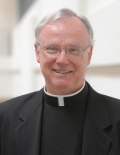 Donald Senior, C.P.
President Emeritus, Chancellor, Professor of New Testament Studies
Donald Senior, C.P., holds a Licentiate in theology (S.T.L.) from the University of Louvain, Belgium and a Doctorate in New Testament Studies (S.T.D.) from the University of Louvain. He has pursued further graduate studies at Hebrew Union College, Cincinnati, Ohio and at Harvard University. Fr. Senior served as President of CTU for 23 years, retiring in July 2013. On April 27, 2015, he was named Chancellor by the CTU Board of Trustees.
A frequent lecturer across the country, Fr. Senior also serves on numerous boards and commissions. He is past President of the Association of Theological Schools of the United States and Canada. In 2001, Pope John Paul II appointed him as a member of the Pontifical Biblical Commission and was reappointed in 2006 and 2008 by Pope Benedict XVI. He has been active in interreligious dialogue, particularly with the Jewish and Muslim communities.
Fr. Senior is the General Editor of The Bible Today and co-editor of the twenty-two volume international commentary series New Testament Message. He is the General Editor of The Catholic Study Bible (Oxford University Press, 1990). He has authored and edited several books and articles.
Donald Senior is a member of the following professional associations: The Catholic Biblical Association of America; The Society of Biblical Literature; Studiorum Novi Testamenti Societas; The Chicago Society of Biblical Research; The Catholic Theological Society of America; The International Association of Missiological Studies; Pax Christi International.
He has served as an official representative to the Southern Baptist/Roman Catholic Scholars Dialogue, sponsored jointly by the National Conference of Catholic Bishops and the Southern Baptist Convention. Fr. Senior just recently ended his term as President of the Association of Theological Schools of the United States and Canada. He is a member of the Board of Directors for Sadlier Publishing Company; the Board of Advisors of the Auburn Center for Theological Education; and the Advisory Committee of the Henry Luce III Fellowship program; and serves on the Executive Committee of the Association of Theological Schools of the United States and Canada. In 1994 he was awarded the Jerome Award for outstanding scholarship by the Catholic Library Association of America. In 1996, the National Catholic Education Association awarded him the Bishop Loras Lane Award for his outstanding contribution to theological education. He is a past President of the Catholic Biblical Association of America (1997-98).