Going Home
Scripture Reflection for the Solemnity of the Ascension of the Lord (Sunday, May 20, 2012)
Acts 1:1-11
Psalm 47
Ephesians 1:17-23
Mark 16:15-20
In most parishes throughout the country, the feast of the Ascension will be celebrated this Sunday. Each of the readings refers to this Christian mystery. The opening part of the Acts of the Apostles is most detailed, with Luke the author describing the final days of the Risen Jesus with his disciples in Jerusalem and then his dramatic ascension into heaven. On the Mount of Olives, a cloud takes the departing Jesus from their sight and the words of two angels who appear on the scene jolt the apostles back to reality: "Men of Galilee, why are you standing there looking at the sky? This Jesus who has been taken up from you into heaven will return in the same way as you have seen him going into heaven."
What is called the "longer ending" of Mark's Gospel (many scholars believe the gospel originally concluded in verse 8 with the words of the angel to the women at the empty tomb of Jesus), describes Jesus' final words of exhortation, promising that those who believe in him will do extraordinary things, and then without elaboration affirms, "Jesus was taken up into heaven and took his seat at the right hand of God" (Mark 16:20). The reading from the Letter to Ephesians is even more succinct; it does not attempt to describe the ascension of Jesus but proclaims that the "Father of glory raised Christ from the dead and seated him at his right hand in glory."
What are we to make of this triumphant conclusion to the life of Jesus? What is the meaning of the Ascension? One important point that is made by the Evangelist Luke in his entire account of Jesus' life, both in the Gospel of Luke and in his second volume, the Acts of the Apostles, is that going home to God is the ultimate conclusion of Jesus' journey. Luke is the one who uses most extensively the metaphor of a "journey" to describe the life of Jesus. In some ways the distant origin of Jesus' journey begins in the history of Israel and its great people of faith. In the infancy narrative, luminous characters such as Zachary and Elizabeth, Anna and Simeon, the shepherds, and, of course Mary and Joseph represent this deep and enduring faith of God's people that he would send a Messiah to them who would lift away the burden of pain and death. From these strong roots Jesus would begin his mission of liberation. That long journey would take him through Galilee, teaching and healing and confronting the power of evil. And ultimately, as Luke notes in 9:51, Jesus "sets his face for Jerusalem" where he would ultimately give his life on the cross and overcome the power of death. But the final destiny of Jesus is not simply Jerusalem or even the triumph of the resurrection - his final resting place is with the "father of glory" who had sent him in the first place. Jesus goes home to a place of ultimate love and communion with the God of love.
Although the readings this Sunday are not drawn from John's Gospel on this feast, this idea of "going home" to God is also very powerful in John's portrayal of Jesus. At his final meal with his disciples, Jesus tells his disciples, "Do not let your hearts be troubled. You have faith in God; have faith in also in me. In my Father's house there are many dwelling places. If there were not, would I have told you that I am going to prepare a place for you?" (John 14:1-2) - words that have been such comfort to those who mourn a loved one.
And this brings us to another dimension of Christian faith in the Ascension of Jesus. The destiny of the Master is also the destiny of the disciple. Many years ago I remember seeing the British movie "Alfie." The main character, Alfie himself, was something of a lost creature - dapper, seemingly self-confident, but inside deeply troubled and unsure of the purpose of his life. The popular theme song that accompanied the movie had the refrain: "What's it all about, Alfie?" Yes, what's it all about? What is the ultimate purpose and meaning of life? In many ways, the story of the Ascension describes from the vantage point of Christian faith not only the ultimate destiny of Jesus but our destiny as well. We are not throwaways but are sons and daughters of a God of infinite love who will never abandon us. Our journey of life continues even beyond death until we reach full communion with God and with all those we love. This is the extraordinary conviction of Christian faith; this is "what it's all about" from the viewpoint of the gospel. This is why the Letter to Ephesians prays that the recipients of the letter will have the "eyes of your hearts be enlightened, that you may know what is the hope that belongs to God's call, what are the riches of glory in his inheritance among the holy ones, and what is the surpassing greatness of his power for us who believe..." (Eph 1:18-19).
Christian faith in the beauty and meaning of life, the conviction that God loves the world and will not abandon it, is the driving force of the Christian mission in the world. That good news - that gospel - is what the Risen Christ asks his disciples to proclaim to the world. In the words of the first reading, the Risen Christ promises to send the Holy Spirit who will empower the disciples to be Christ's witnesses to the whole world, "throughout Judea and Samaria, and to the ends of the earth" (Acts 1:8). And that is why this feast of the Ascension does not leave us staring up into the sky, confused, but sends us forth with purpose into the world.
Image: Giotto di Bondone (1267-1337), Cappella Scrovegni a Padova, Ascension - Public domain.
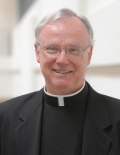 Donald Senior, C.P.
President Emeritus, Chancellor, Professor of New Testament Studies
Donald Senior, C.P., holds a Licentiate in theology (S.T.L.) from the University of Louvain, Belgium and a Doctorate in New Testament Studies (S.T.D.) from the University of Louvain. He has pursued further graduate studies at Hebrew Union College, Cincinnati, Ohio and at Harvard University. Fr. Senior served as President of CTU for 23 years, retiring in July 2013. On April 27, 2015, he was named Chancellor by the CTU Board of Trustees.
A frequent lecturer across the country, Fr. Senior also serves on numerous boards and commissions. He is past President of the Association of Theological Schools of the United States and Canada. In 2001, Pope John Paul II appointed him as a member of the Pontifical Biblical Commission and was reappointed in 2006 and 2008 by Pope Benedict XVI. He has been active in interreligious dialogue, particularly with the Jewish and Muslim communities.
Fr. Senior is the General Editor of The Bible Today and co-editor of the twenty-two volume international commentary series New Testament Message. He is the General Editor of The Catholic Study Bible (Oxford University Press, 1990). He has authored and edited several books and articles.
Donald Senior is a member of the following professional associations: The Catholic Biblical Association of America; The Society of Biblical Literature; Studiorum Novi Testamenti Societas; The Chicago Society of Biblical Research; The Catholic Theological Society of America; The International Association of Missiological Studies; Pax Christi International.
He has served as an official representative to the Southern Baptist/Roman Catholic Scholars Dialogue, sponsored jointly by the National Conference of Catholic Bishops and the Southern Baptist Convention. Fr. Senior just recently ended his term as President of the Association of Theological Schools of the United States and Canada. He is a member of the Board of Directors for Sadlier Publishing Company; the Board of Advisors of the Auburn Center for Theological Education; and the Advisory Committee of the Henry Luce III Fellowship program; and serves on the Executive Committee of the Association of Theological Schools of the United States and Canada. In 1994 he was awarded the Jerome Award for outstanding scholarship by the Catholic Library Association of America. In 1996, the National Catholic Education Association awarded him the Bishop Loras Lane Award for his outstanding contribution to theological education. He is a past President of the Catholic Biblical Association of America (1997-98).