The Field is the World


Scripture Reflection for the Sixteenth Sunday in Ordinary Time (July 20, 2014)
Scripture Readings:
Wisdom 12:13, 16-19
Psalm 86:5-6, 9-10, 15-16
Romans 8:26-27
Matthew 13:24-43 or 13:24-30
Recently Pope Francis visited the Calabrian region of Italy located at the southern tip of the Italian boot. It is an exceedingly poor and depressed area, with 59% unemployment and, worse, it is in the death grip of the Mafia which controls all aspects of the region's life. When the Pope arrived there he did what we have come to expect of this gracious and loving man: he visited a hospital, a prison, and a home for developmentally disabled persons. Then he went for a public Mass in the town square and the more than 100,000 people gathered there saw a different side of Pope Francis - he denounced the evil of the Mafia in the strongest terms, telling them to turn from their evil ways or else face excommunication and God's wrath. He also told the people in the square to say "no" to the evil ways of these powerful criminals and not to cooperate with them. So strong was the Pope's condemnation of the Mafia that a government attorney worried that the Pope may have put himself at personal risk.
I mention these different dimensions of the Pope's message to his people in the light of the Scripture readings we have for this Sunday. The Pope's words and deeds reflect, in fact, the different faces of both the God of the Old Testament and of Jesus in the New. The first reading from the book of Wisdom reminds us of God's awesome power who has "mastery over all things" and is the "master of might." There is "no god besides you who have the care of all." Thus it is imperative to obey God's will. Jesus, too, did not hesitate to condemn the hypocrisy of the religious leaders or of those who ignored the suffering of the poor thereby violating God's commands.
Yet this same passage from Wisdom reminds us that despite God's all powerful might, God is kind and tender, judging us with "clemency" and "lenience." Jesus, too, preached God's mercy and compassion without cease. It is this latter motif of God's mercy that is emphasized in the Psalm response - a motif that runs like a bright stream through the entire Bible: "Lord, you are good and forgiving, abounding in kindness to all who call upon you ... You, O Lord, are a God merciful and gracious, slow to anger, abounding in kindness and fidelity." How far from the truth are those who say that the God of the Old Testament is a God of anger and retribution.
These selections from the Old Testament are meant to amplify motifs found in the Gospel reading. This Sunday we have a medley of parables from the Gospel of Matthew. The first one, the Parable of the Wheat and the Weeds, is found only in Matthew's Gospel and reflects the forbearance of the God proclaimed by Jesus. In the story an enemy sows weeds among the farmer's field of wheat. His workers want to pull the weeds up right away but the Master is more patient, counseling them to let the wheat and the weeds grow together and let the sorting out of good and evil be done at the "harvest" time. In the context of Matthew's Gospel we sense here both the realism of Jesus (the world is a mixed bag!) and his patience with sinners for whom his love and tender mercy are always available.
In the explanation of this parable that comes at the end of the Gospel selection, Jesus tells his disciples the key to its meaning: "the field is the world" and it is not surprising that both good and evil exist in this human arena. Those who choose a life of evil will be held accountable for their toxic choice (we think of the Pope's powerful indictment of the Mafia!), but in the meantime the good seed must grow in the world. This is a key point for Matthew's mission theology: the object of the message of repentance and hope brought by Jesus is not Israel or the Church but the world. At the very end of Matthew's Gospel, the Risen Jesus will send his missionary disciples out into the world to proclaim the Gospel to "all nations" (Matt 28:16-20). God's mercy is available to all.
Two other enticing parables of Jesus are included in this Sunday's reading and both speak with exuberant hope about the ultimate triumph of the "Kingdom of Heaven" (note, by the way, that Matthew's Jewish sensitivity substitutes the usual phrase "Kingdom of God" with the more reverential "Kingdom of Heaven" - thus avoiding a direct reference to God). The coming of God's reign or kingdom was a keynote of Jesus' mission and it proclaimed that ultimately nothing could stand in the way of God's loving will for his people. Despite the presence of evil in the world, God's children would flourish with abundant and everlasting life. Thus the Kingdom of Heaven was like a mustard seed that would blossom and grow into a "large bush" where the birds of the sky could make their nests and dwell in its branches. Or the Kingdom was like a woman who kneads yeast into a mound of flour (three measures - enough bread to feed a village) and the whole batch becomes leavened and ready to bake!
One New Testament scholar has described the God of the Bible as one who is "awesomely transcendent and infinitely tender." Both of those divine qualities appear in our readings this Sunday.
Image: Sun Rays Over Field of Grain by Ken Kistler. License: Public Domain.
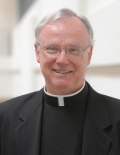 Donald Senior, C.P.
President Emeritus, Chancellor, Professor of New Testament Studies
Donald Senior, C.P., holds a Licentiate in theology (S.T.L.) from the University of Louvain, Belgium and a Doctorate in New Testament Studies (S.T.D.) from the University of Louvain. He has pursued further graduate studies at Hebrew Union College, Cincinnati, Ohio and at Harvard University. Fr. Senior served as President of CTU for 23 years, retiring in July 2013. On April 27, 2015, he was named Chancellor by the CTU Board of Trustees.
A frequent lecturer across the country, Fr. Senior also serves on numerous boards and commissions. He is past President of the Association of Theological Schools of the United States and Canada. In 2001, Pope John Paul II appointed him as a member of the Pontifical Biblical Commission and was reappointed in 2006 and 2008 by Pope Benedict XVI. He has been active in interreligious dialogue, particularly with the Jewish and Muslim communities.
Fr. Senior is the General Editor of The Bible Today and co-editor of the twenty-two volume international commentary series New Testament Message. He is the General Editor of The Catholic Study Bible (Oxford University Press, 1990). He has authored and edited several books and articles.
Donald Senior is a member of the following professional associations: The Catholic Biblical Association of America; The Society of Biblical Literature; Studiorum Novi Testamenti Societas; The Chicago Society of Biblical Research; The Catholic Theological Society of America; The International Association of Missiological Studies; Pax Christi International.
He has served as an official representative to the Southern Baptist/Roman Catholic Scholars Dialogue, sponsored jointly by the National Conference of Catholic Bishops and the Southern Baptist Convention. Fr. Senior just recently ended his term as President of the Association of Theological Schools of the United States and Canada. He is a member of the Board of Directors for Sadlier Publishing Company; the Board of Advisors of the Auburn Center for Theological Education; and the Advisory Committee of the Henry Luce III Fellowship program; and serves on the Executive Committee of the Association of Theological Schools of the United States and Canada. In 1994 he was awarded the Jerome Award for outstanding scholarship by the Catholic Library Association of America. In 1996, the National Catholic Education Association awarded him the Bishop Loras Lane Award for his outstanding contribution to theological education. He is a past President of the Catholic Biblical Association of America (1997-98).