Families - Then and Now
Scripture Reflection for Sunday, December 26, 2010:
Scripture Readings:
Sir 3:2-6, 12-14
Psalm 128
Col 3:12-21
Mt 2:13-15, 19-23
Going to Sunday Mass the day after Christmas may seem a bit like trying to get enthused about leftovers the day after a glorious banquet. But take another look at this “Holy Family Sunday,” the traditional celebration that takes place each year on the Sunday after Christmas. We all know that for many Americans, the “family” they experience often does not match the picture perfect ideal that appears in some ads and is lifted up in traditional Christmas carols (and even in Psalm 128 that we hear today where the family is described as a beautiful vine or bounteous olive plant wrapping around the family table).
There are broken families, single parent families, extended families, families struggling to make ends meet, and just ordinary families with their share of joys, tensions, conflicts and sorrows.
Yet, as the powerful Scripture readings for this Sunday remind us, no matter what the circumstances, striving for mutual love, respect, and a spirit of forgiveness remain the heart of any family life worth living.
The Scripture selections reflect different dimensions of family life. The first reading is from Sirach, one of the so-called “wisdom” books of the Old Testament that drew on common sense human experience enhanced with a spirit of faith. In this passage the author reflects on the intergenerational obligations of family life. The parents have God-given responsibility for their children and are to nourish and care for them. At the same time, however—and this is the emphasis of this passage—children are to respect and honor their parents.
Caring for an aging parent can become a delicate and sometimes frustrating task. The reading from Sirach reminds in a touching way that adult children who are now in their prime, no matter how frustrated or anxious they may be, should not revile an elderly parent when their strength is ebbing and perhaps their memory is failing. Words spoken twenty-one centuries ago still have pointed meaning for us today!
In Paul’s letter to Colossians we have a beautiful word portrait of the virtues that should animate the Christian family. Along with the expected exhortation to love and compassion there are also virtues listed which speak of the reality of living together: patience, bearing with one another, forgiving one another. Paul, who was no stranger to conflict in his communities, offers us a vision of life together that is both lyrical and practical.
The Lectionary gives us the option of leaving off the last paragraph of the passage that speaks of the relationship of husband and wives in a manner that reflects the social structures of the first century (“Wives, be subordinate to your husbands…Husbands, love your wives…”). Yet here, too, the underlying thought leaps across the centuries and vast cultural canyons into our own time: avoid bitterness, love and respect each other.
The Gospel reading is from Matthew and brings a strong dose of realism about the kind of family life that many people around the globe actually experience today. Joseph is warned in a dream to take his family and flee to Egypt because a murderous despot, Herod, threatens the life of the child, fearing a potential rival to his power.
As in the Exodus stories, Egypt is often depicted in the Bible as a place of slavery and oppression but it was also a place of refuge in times of trouble: Abraham sought food there and Joseph and his family found a home there, too, in a time of famine. Matthew’s depiction of the Holy Family fleeing to Egypt evokes those troubled chapters of Israel’s history. And even when Herod dies and the family of Jesus is called back home, they really can’t “go home” because Archelaus, the son of Herod (and as history confirms, a despot, too) is now ruling over their home region of Judea which includes Bethlehem. So they go to Nazareth instead—and the rest is history.
Matthew concludes this story of woe with a hint of hope: he cites a mysterious biblical allusion (no actual text like this is found in the Old Testament): “He shall be called a Nazorean” (Mt 2:23). Most interpreters think that Matthew is playing on the Hebrew word nazir which means a “sprig” or “shoot.”
Isaiah 11—a beautiful text used in our Advent liturgy---speaks of a “shoot (nazir) sprouting from the stump of Jesse” – a lovely metaphor that promises that even though the Davidic dynasty (Jesse was the father of King David) may experience tragedy yet in coming of Jesus the hopes would be fulfilled.
Matthew’s depiction of the travails of the Holy Family is eerily modern—at a time when so many families throughout the world are forced to be homeless refuges and when immigrant families in our own country are broken apart and cruelly separated. For the millions of families in these situations the ordinary challenges of family life are compounded many times over.
For all of us who love and cherish our families and what they have meant to us, this Sunday is a time to reflect on what is the heart of our family life and to what extent is it a reflection of the faithful and forgiving love that God has for all of us, his human family. Confident in that divine love we turn to the nourishment of the Eucharist to help sustain us.
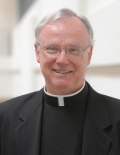 Donald Senior, C.P.
President Emeritus, Chancellor, Professor of New Testament Studies
Donald Senior, C.P., holds a Licentiate in theology (S.T.L.) from the University of Louvain, Belgium and a Doctorate in New Testament Studies (S.T.D.) from the University of Louvain. He has pursued further graduate studies at Hebrew Union College, Cincinnati, Ohio and at Harvard University. Fr. Senior served as President of CTU for 23 years, retiring in July 2013. On April 27, 2015, he was named Chancellor by the CTU Board of Trustees.
A frequent lecturer across the country, Fr. Senior also serves on numerous boards and commissions. He is past President of the Association of Theological Schools of the United States and Canada. In 2001, Pope John Paul II appointed him as a member of the Pontifical Biblical Commission and was reappointed in 2006 and 2008 by Pope Benedict XVI. He has been active in interreligious dialogue, particularly with the Jewish and Muslim communities.
Fr. Senior is the General Editor of The Bible Today and co-editor of the twenty-two volume international commentary series New Testament Message. He is the General Editor of The Catholic Study Bible (Oxford University Press, 1990). He has authored and edited several books and articles.
Donald Senior is a member of the following professional associations: The Catholic Biblical Association of America; The Society of Biblical Literature; Studiorum Novi Testamenti Societas; The Chicago Society of Biblical Research; The Catholic Theological Society of America; The International Association of Missiological Studies; Pax Christi International.
He has served as an official representative to the Southern Baptist/Roman Catholic Scholars Dialogue, sponsored jointly by the National Conference of Catholic Bishops and the Southern Baptist Convention. Fr. Senior just recently ended his term as President of the Association of Theological Schools of the United States and Canada. He is a member of the Board of Directors for Sadlier Publishing Company; the Board of Advisors of the Auburn Center for Theological Education; and the Advisory Committee of the Henry Luce III Fellowship program; and serves on the Executive Committee of the Association of Theological Schools of the United States and Canada. In 1994 he was awarded the Jerome Award for outstanding scholarship by the Catholic Library Association of America. In 1996, the National Catholic Education Association awarded him the Bishop Loras Lane Award for his outstanding contribution to theological education. He is a past President of the Catholic Biblical Association of America (1997-98).