Everything Belongs to God


Scripture Reflection for the Twenty-Ninth Sunday in Ordinary Time (October 19, 2014)
Scripture Readings:
Isaiah 45:1, 4-6
Psalm 96:1, 3, 4-5, 7-8, 9-10
1 Thessalonians 1:1-5b
Matthew 22:15-21
In one of his famous interviews with a journalist, Pope Francis noted that "God is not a Catholic" - a comment that startled many! The Pope, of course, is an exemplary Catholic and has nothing but love for his Catholic faith. The truth he was expressing is that all people belong to God, no matter what their religious, or for that matter, non-religious persuasion may be. This was also the strong conviction of Paul the Apostle - he was convinced that God was not a Jew either. The God of Israel was also the God of the Nations. Paul intensely loved his Jewish heritage and Jewish practice and never renounced his Jewish faith. But his encounter with the Risen Christ, and the call he felt God had given him to preach the Gospel to the Gentiles, reminded him, too, that God was the Lord of the Universe and all the peoples therein.
The readings for this Sunday also remind us of the majesty of God and the wide embrace of God's love - both for his people Israel and for the nations. In the first reading from Isaiah, we have a remarkable comment about Cyrus, the King of Persia (600-530 BC). During his long reign Cyrus extended his empire throughout much of the Middle East and became known as an enlightened ruler, particularly respecting the religion and shrines of the peoples he conquered. Although scholars debate the details, the Bible is convinced that Cyrus was the one who ended Israel's exile and helped restore the Jerusalem temple. His edict of liberation is cited in 2 Chronicles 36:23 and in the book of Ezra 6:3-5. In the passage we hear this Sunday, the prophet Isaiah goes a step further and calls Cyrus God's "anointed," that is, the "messiah." This is the only instance in the Bible in which a non-Jew is given such a noble designation.
Isaiah dares to recognize that God works through even someone like the King of Persia (present-day Iran) who, as the text notes, doesn't even know God, to ultimately restore the people of Israel. The reason is God's all-encompassing power and might: "I am the Lord and there is no other" - the text repeats twice. And God's power, this text underscores, is used to express God's love and care for his people.
The exuberant Psalm response for this Sunday, drawn from Psalm 96, echoes this sense of God's transcendent presence: "Give to the Lord, you families of nations, give to the Lord glory and praise!" The Hebrew Scriptures were focused on the fate of Israel but were always aware that God was also the God of the Nations and, indeed, of the Universe itself.
The Gospel selection from Matthew this Sunday is the famous encounter between Jesus and the Pharisees about the issue of paying taxes to Caesar. Attempting to "entrap" Jesus, some of the disciples of the Pharisees and some "Herodians" (probably supporters of Herod Antipas who was the current ruler in Lower Galilee where Jesus exercised most of his ministry) pose a dilemma for Jesus: should one pay taxes to Caesar and thus recognize the Emperor's authority over Israel? Or should one refuse to pay the tax and then have to suffer the consequences?
Jesus will not become ensnarled in this debate because he judges that his opponents are not sincere and simply want to trap him. In response he asks them to produce the coin used to pay the tax, the Roman denarius which, in fact, was imprinted with the bust of Tiberius Caesar and bore the Latin inscription: "Tiberius Caesar, august son of the Divine High Priest Augustus."
There is surely irony here in that his opponents would be carrying on their person a coin with the Emperor's image and with such a sacrilegious inscription. When Jesus asks them "whose image is this and whose inscription?" they are forced to concede that it is "Caesar's." And in a brilliant stroke he slips out of their trap with this famous reply: "then repay to Caesar what belongs to Caesar and to God what belongs to God."
Many interpreters, especially in our country, have considered this saying of Jesus as support for the civil doctrine of separation of church and state. But it is very doubtful that the Gospel account had this modern issue in mind. It is more likely that Jesus conceded the practical necessity of paying the tax - "repay to Caesar what belongs to Caesar." (Just as he had earlier in Matthew's Gospel, when Jesus instructed Peter to retrieve a coin from the mouth of a fish and pay the temple tax for both of them! See Mt 17:24-27.) What is key in this Gospel passage, however, is Jesus' declaration: "...repay...to God what belongs to God."
The fundamental question here is what does "belong to God?" Those attuned to the Scriptures and to the faith of both Israel and Christianity confess that all things belong to God - even whatever legitimate power Caesar might claim is ultimately subordinate to God's rule. Here this Gospel story aligns with the first reading from Isaiah that portrayed Cyrus the Great as God's anointed and the response from Psalm 96 that praises the God of the Universe. All things belong to God, a God whose characteristic exercise of power is not to oppress or exploit but to liberate and love.
The readings this Sunday, therefore, remind us of God's great majesty and call on us to lift our hearts and voices in praise and thanksgiving. In the words of the Psalm: "Give to the Lord glory and honor. Sing to the Lord a new song; sing to the Lord, all you lands!"
© Copyright 2014 Catholic Theological Union. All Rights Reserved.
Image: Money Pounds by George Hodan. www.publicdomainpictures.net
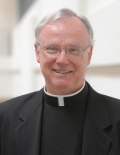 Donald Senior, C.P.
President Emeritus, Chancellor, Professor of New Testament Studies
Donald Senior, C.P., holds a Licentiate in theology (S.T.L.) from the University of Louvain, Belgium and a Doctorate in New Testament Studies (S.T.D.) from the University of Louvain. He has pursued further graduate studies at Hebrew Union College, Cincinnati, Ohio and at Harvard University. Fr. Senior served as President of CTU for 23 years, retiring in July 2013. On April 27, 2015, he was named Chancellor by the CTU Board of Trustees.
A frequent lecturer across the country, Fr. Senior also serves on numerous boards and commissions. He is past President of the Association of Theological Schools of the United States and Canada. In 2001, Pope John Paul II appointed him as a member of the Pontifical Biblical Commission and was reappointed in 2006 and 2008 by Pope Benedict XVI. He has been active in interreligious dialogue, particularly with the Jewish and Muslim communities.
Fr. Senior is the General Editor of The Bible Today and co-editor of the twenty-two volume international commentary series New Testament Message. He is the General Editor of The Catholic Study Bible (Oxford University Press, 1990). He has authored and edited several books and articles.
Donald Senior is a member of the following professional associations: The Catholic Biblical Association of America; The Society of Biblical Literature; Studiorum Novi Testamenti Societas; The Chicago Society of Biblical Research; The Catholic Theological Society of America; The International Association of Missiological Studies; Pax Christi International.
He has served as an official representative to the Southern Baptist/Roman Catholic Scholars Dialogue, sponsored jointly by the National Conference of Catholic Bishops and the Southern Baptist Convention. Fr. Senior just recently ended his term as President of the Association of Theological Schools of the United States and Canada. He is a member of the Board of Directors for Sadlier Publishing Company; the Board of Advisors of the Auburn Center for Theological Education; and the Advisory Committee of the Henry Luce III Fellowship program; and serves on the Executive Committee of the Association of Theological Schools of the United States and Canada. In 1994 he was awarded the Jerome Award for outstanding scholarship by the Catholic Library Association of America. In 1996, the National Catholic Education Association awarded him the Bishop Loras Lane Award for his outstanding contribution to theological education. He is a past President of the Catholic Biblical Association of America (1997-98).