
Corpus Christi


Scripture Reflection for the Solemnity of the Most Holy Body and Blood of Christ (Corpus Christi) (Sunday, June 7, 2015)
Scripture Readings:
Exodus 24:3-8
Psalm 116
Hebrews 9:11-15
Mark 14:12-16, 22-26
Perhaps no other liturgical feast is more "Catholic" than Corpus Christi (Latin for "the Body of Christ"). My memories of this feast have a particular twist. Part of my boyhood took place in Louisville, Kentucky, where my family had moved in the early 1950's from our hometown of Philadelphia. Soon after we arrived, we were plunged into a unique Kentucky form of celebrating Corpus Christi - a gigantic procession involving tens of thousands at the famed racetrack of Churchill Downs, the site of the Kentucky Derby. The Archbishop, all of the clergy and religious, the altar boys (I was one of these ...), and representatives from every parish sodality, Knights of Columbus chapters, and other assorted parish organizations were expected to march, with thousands more "ordinary" Catholics filling the massive grandstand of the race track to cheer us on. Around the track we walked in a solemn march, with bands playing and people singing, led by the Archbishop carrying the monstrance under a canopy held by fully uniformed fourth-degree Knights.
It was a sight to behold, and I am sure that was the point. For one special day, Louisville, a city in those days with a strong representation of Southern Baptists, would see Catholics out in force - and celebrating something that was characteristic of Catholic life - devotion to the Eucharist! (Permit a distraction that adds charm to this Louisville form of Corpus Christi celebration. For many years, the long-serving Archbishop Floersh of Louisville forbade priests to go to the races at Churchill Downs, considering it improper for priests to be involved with such a thing as horse racing and betting. The story is told that at one race a horse threw his jockey right in front of the main grandstand, and the jockey appeared to be severely injured. All at once 100 men in black trousers and a variety of sport shirts instinctively jumped up in various parts of the grandstand and gave the injured man a blessing of general absolution.) Back to the readings for this feast ...
What is it about Corpus Christi that makes it so "Catholic?" After all, other Christian denominations revere the Lord's Supper and are aware of the New Testament traditions about this. But Catholicism is a strongly sacramental religion, firmly believing, in the case of the Eucharist, that Christ is truly present in the consecrated bread and wine. Similarly we believe that God's grace is present and active in all of the created elements of the sacraments - in the waters of baptism, in the oil of confirmation, in the Church's words of absolution in the sacrament of reconciliation, in the vowed love of a man and woman in marriage, in the laying on of hands at ordination, in the healing touch and oil of the sacrament of anointing. All of this is rooted in the centrality of our faith in the Incarnation - the Divine and Eternal Son of God, born out of the love of the Trinity, becomes true flesh, taking on human existence and revealing that all of God's creation, and particularly the human person made in the image of God, is sacred and shot through with God's loving presence.
And the readings for this Corpus Christi Sunday reflect some of the profound meaning of the Eucharist for us. In a key text from Exodus, Moses celebrates the covenant God made with Israel with a solemn ritual of sacrifice. God would from then on be present to Israel, especially in his words to them in the sacred Law of Moses - guiding them on how to obey God's will and thus find life.
The second reading is from the Letter to the Hebrews, a unique New Testament text that tries to understand the redemptive work of Christ through an elaborate metaphor that compares the now-past Jerusalem temple and its liturgy with the continuing heavenly liturgy that Christ celebrates in the presence of God. Jesus, the great "High Priest," offers a pleasing sacrifice to God, not with the blood of animals as marked the earthly Jerusalem temple, but with the blood of Christ poured out for us. Jesus' sacrifice consisted of his love for us that would motivate his having to endure death itself for our sake. Jesus' giving of his life was not a ritual act, but a true giving of life, because of his fidelity to his ministry of justice and reconciliation. His opponents imposed death on him through crucifixion in an attempt destroy him and his mission, but God raised Jesus from death to life and, in so doing, revealed our own destiny of conquering death through enduring love.
And finally we have the account of the Last Supper from Mark's Gospel. From the very beginning, Christians have recognized in the words and gestures of Jesus and the meaning of this final Passover meal with his disciples as the origin of the Eucharist. The Passover was - and is - one of Judaism's most solemn festivals, its meaning evolving over time, but constant in its remembrance of the great liberation from slavery in Egypt and the long journey to the Promised Land. More than any other Old Testament tradition, the Exodus and its remembrance in the Passover ritual define the God of Israel - and the God of Jesus - as a liberating God who hears the cry of his poor and comes to give them life. It was on this very feast - filled with poignancy because it was on the eve of his passion - that Jesus used the elements of bread and wine to tell his disciples once more the true meaning of his impending death: "This is my body - given up for you ... This is my blood of the covenant, which will be shed for you." For Jesus' opponents, who at that very moment were beginning to close in on him, Jesus' death would be the final verdict that would discredit his mission; but for Jesus and his Father, his love for his own would not be destroyed and would be raised up to new life.
Here in condensed form are the reasons we revere the Eucharist: sign of God's enduring love for us made visible in the Word made flesh; remembrance of Jesus' giving of his life for us; revelation of the bond of love and reconciliation that ties us together as a believing community; and vital nourishment and deep comfort for us as we journey to the Promised Land. "Do this in memory of me," Christ tells his church.
This feast is one of those rare moments in the liturgical year where there is a "sequence" - a poem-like hymn that comes between the second reading and the Gospel. For this feast the "sequence" is a long Latin hymn, Lauda Sion ("Sion, give praise...") written by St. Thomas Aquinas in 1264, expressly for Corpus Christi. We can conclude our reflection with one of its final verses:
Very bread, good shepherd, tend us,
Jesu, of your love befriend us,
You refresh us, you defend us,
Your eternal goodness send us
In the land of life to see
This reflection was originally published at www.ctu.edu. © Copyright 2015 Catholic Theological Union. All Rights Reserved.
Image: Adoro Te devote latens Deitas by Lawrence, OP
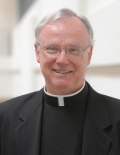 Donald Senior, C.P.
President Emeritus, Professor of New Testament Studies
Donald Senior, C.P., holds a Licentiate in theology (S.T.L.) from the University of Louvain, Belgium and a Doctorate in New Testament Studies (S.T.D.) from the University of Louvain. He has pursued further graduate studies at Hebrew Union College, Cincinnati, Ohio and at Harvard University.
A frequent lecturer across the country, Fr. Senior also serves on numerous boards and commissions. He is past President of the Association of Theological Schools of the United States and Canada. In 2001, Pope John Paul II appointed him as a member of the Pontifical Biblical Commission and was reappointed in 2006 and 2008 by Pope Benedict XVI. He has been active in interreligious dialogue, particularly with the Jewish and Muslim communities.
Fr. Senior is the General Editor of The Bible Today and co-editor of the twenty-two volume international commentary series New Testament Message. He is the General Editor of The Catholic Study Bible (Oxford University Press, 1990). He has authored and edited several books and articles.
Donald Senior is a member of the following professional associations: The Catholic Biblical Association of America; The Society of Biblical Literature; Studiorum Novi Testamenti Societas; The Chicago Society of Biblical Research; The Catholic Theological Society of America; The International Association of Missiological Studies; Pax Christi International.
He is also a past president of CTU.